
History
The History of Motels
The story of the American motel, decade by decade. Start before it had a name, roll through the neon golden age, and arrive at the interstate era that rewrote everything.
Before the interstate, before the chains, the motel grew up right alongside the American road trip. Follow it from the first roadside inns that welcomed early motorists, through the neon and kidney-shaped pools of its golden age, to the fast new highways that quietly changed everything. Each chapter is a short, true story of how we came to travel the way we do.
Before the Motel
There was no sign to look for, because there was nothing yet to name. You drove until the light gave out, the road going to dust and washboard under the tires, and you took what you could find: a cot in a farmer's spare room, a patch of grass at an auto camp, a creaky bed above a roadhouse. You washed at a pump and cooked over a fire and slept with the windows down. It was not comfortable and it was not certain, but the whole country had suddenly come within reach, and that was the thing you could not stop chasing.
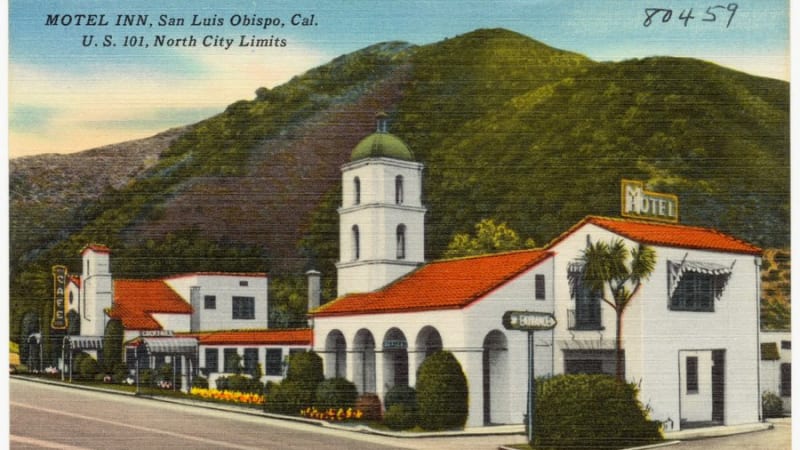
The 1930s
Now there was a place made just for you. A little cabin of your own in a horseshoe of identical cabins, a garage beside it so your car slept where you could see it. A wooden key fob, a chenille bedspread, a bare bulb overhead. Money was thin and the road was long, but a dollar bought a clean bed and a door that locked, and after a day of dust that felt like plenty.
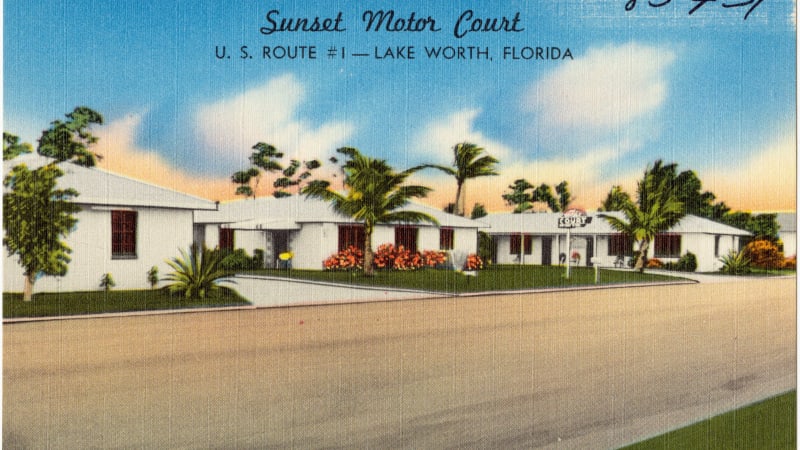
The 1940s
For a few years the courts went quiet. Gas was rationed, tires were scarce, and the open road felt almost unpatriotic. Then the war ended and the whole country seemed to exhale and reach for the keys at once. You could feel it in the fresh coat of paint, the brand-new sign, the pool being poured out back. Everyone was going somewhere, and for the first time it felt like the somewhere was meant for everybody.
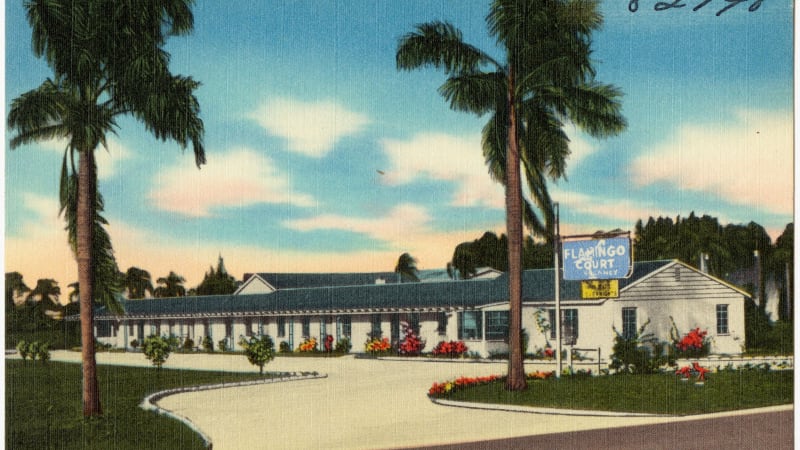
The 1950s
This was the top of the mountain. The neon spelled WELCOME in cursive against the dusk, the pool glowed a chlorinated turquoise, and the sign out front made promises that felt like the future: air conditioning, a television in every room, a coffee shop next door. You pulled in off the two-lane with your tail fins gleaming, and for one night you got to feel modern and taken care of, both at once.
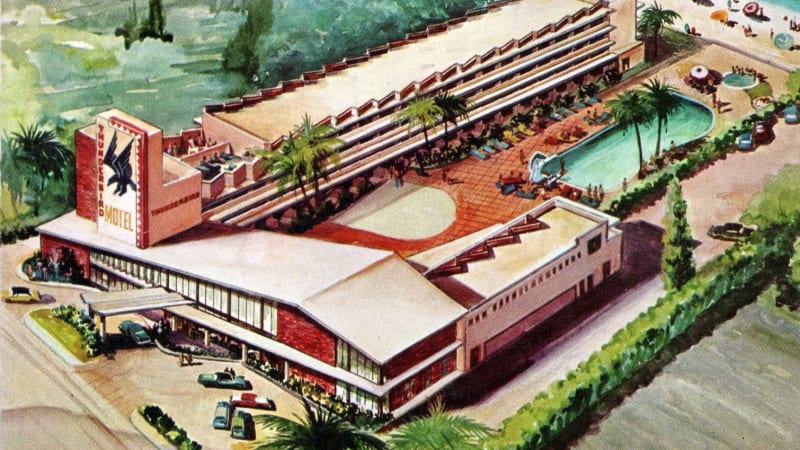
The 1960s
The look went gloriously wild. Tiki torches and Googie angles, Wild West fronts and Space Age signs, each place shouting to be the one you would remember. But out past the edge of town a new kind of road was being poured, wide and fast and straight, and it did not need the little courts that lined the old highway. You could feel the glamour at its peak and, if you listened, the faint sound of the exit ramp going in somewhere up ahead.
Common questions about motel history
What is the difference between a motel and a hotel?
A motel was built for the car. The name is short for "motor hotel," and the classic layout puts your room's door right on the parking lot, so you park a few steps from your bed. A hotel is usually a larger, multi-story building with interior hallways, a lobby, and rooms you reach by elevator. The simplest test: at a motel you can almost always see your car from your door, while at a hotel you hand it to a valet or leave it in a garage. Motels grew up along the open road for travelers passing through, while hotels tend to sit in town for a longer stay.
What is the difference between a motel and a motor court?
A motor court was the earliest form: a horseshoe of separate little cabins, often with a garage between each so you parked right beside your room. As they grew into single connected buildings with rooms in a row, the name shortened to "motel," a blend of motor and hotel. So a motor court is essentially an early, cabin-style motel, and you can still spot the older name on vintage neon signs from the 1930s and 1940s.
When was the word "motel" invented?
In 1925, coined for the Milestone Mo-Tel in San Luis Obispo, California, from "motor" and "hotel." As the story goes, architect Arthur Heineman wanted to call it the Milestone Motor Hotel but could not fit all of that on the sign, so he shortened it. It took a couple of decades to catch on everywhere, but by the 1950s the word was on signs from coast to coast.
Why do so many vintage motels have neon signs and pools?
The 1950s were the motel's golden age, when owners competed for road-trippers by advertising modern comforts. A glowing neon sign you could spot at night, a kidney-shaped pool, air conditioning, and a television in every room all said the same thing: pull in here, we have the future. The pool did double duty, cooling families off before air conditioning was everywhere and giving a plain roadside stop the feel of a resort.
What ended the golden age of the roadside motel?
Two things, mostly: the Interstate Highway System, begun in 1956, and the rise of national chains. Fast new highways bypassed the old two-lane roads that independent motels depended on, so a town that once sat on a busy route could suddenly find itself a few miles off the new exit. Predictable chains then drew travelers who wanted a room exactly like the last one, and many family-run courts could not keep up.
Can you still stay at a historic motel today?
Yes. Many mid-century motor courts and motels have been lovingly restored, their neon relit and their pools refilled, and they are bookable right now. A good restoration gives you the best of both eras: the character and the location of the original, with the comfortable bed and clean bathroom you expect today. Finding the best independent, full-of-character ones and mapping them for a road trip is exactly what Boutels is for.